
In this guide
- 1. Where the housekeeping gap is
- 2. Seasonal or year-round: choose the permit first
- 3. The shortage list, the labour-market test and your county
- 4. What the hospitality agreement says you pay
- 5. The Thai side and the visa in Bangkok
Where the housekeeping gap is
Croatia's employment service, HZZ, gives its opinion before most work permits for workers from outside the EU are issued, and its figures show where hotels are short. From January to September 2026 it received 111,198 requests and issued 77,055 positive opinions. Room attendants accounted for 3,453 of them, at an average offered wage of 1,137.07 euros gross a month. Cleaners took another 6,318, and assistant cooks and assistant waiters more than 10,000 each.
The demand sits on the coast and in the capital. Istria filed the most requests of any county, 16,960, followed by Zagreb with 16,270 and Split-Dalmatia with 15,645. Primorje-Gorski Kotar and Dubrovnik-Neretva added close to 19,000 between them. A resort in Istria and a city hotel in Zagreb are hiring the same housekeepers, on different calendars.
Housekeeping is also the department where a foreign crew settles in fastest. The work is learned on the floor, measured in rooms per shift and inspected every day, and it needs less Croatian than the front desk or the restaurant. A team that already knows hotel standards from Thailand's own resort industry starts much closer to your pace than a first-season recruit with no hotel background.
Seasonal or year-round: choose the permit first
The amendments to the Foreigners Act in force since 4 June 2026 let a seasonal permit run for up to three years with the same employer. Within it the worker may work up to 90 days or up to nine months a year, depending on the type of seasonal work, and the period is stated in the application. A resort that opens from April to October should settle the full season in the first application rather than plan to extend it later.
Two rules make the seasonal permit different. A seasonal worker cannot change employer while the permit runs, which a standard permit holder may do after six months. And seasonal workers are exempt from the Croatian language exam that applies to other permit holders from June 2027. For a coastal hotel that reopens with the same crew each spring, it is the better instrument.
A city hotel open all year needs the standard work and residence permit instead. It runs for the length of the contract, up to three years, and the worker may move to another employer after six months. From 4 June 2027, a worker on this permit who has lived in Croatia for more than a year must pass an A1.1 Croatian and Latin-script exam before renewing, and the employer pays for the test. A housekeeper who starts lessons in Bangkok does not face that exam cold.
Either way, the police administration has 90 days to decide from a complete application. For a standard permit an exceptional case can take 30 more, for a seasonal one it cannot. Plan the season from that number, not from the 15 days the law allowed before June.
The shortage list, the labour-market test and your county
Before the police decide, HZZ decides whether a Croatian candidate could take the job. If room attendant is on the shortage list for your police administration area, there is no labour-market test. If it is not, HZZ runs the test first. The list is set area by area, so the same job can be listed in one area and tested in the next, and what counts is the area where the hotel is.
Where the test is run, the permit is only valid in the area where it was run, and a shortage-occupation permit only where the occupation is listed. A group that moves housekeepers between a hotel in Istria and one in Dalmatia needs both areas on the permits, which can be done by testing in more than one area, before or after the permit is issued. What does not work is sending the crew south first and doing the paperwork later.
The list also decides your ratio. Since June 2026, your full-time domestic staff - Croatian, EU, EEA or Swiss nationals and Croatian emigrants - must number at least 20% of the third-country workers you employ in tested occupations, or 10% in shortage occupations. A company with 12 full-time domestic employees can carry up to 60 foreign workers in tested jobs, or up to 120 in listed ones. Do that sum for the employing company before you plan headcount.
Two money tests sit beside it. A company needs inflows of at least 100,000 euros over the previous twelve months, a sole trader 40,000, and no account may have been blocked for more than 30 days in a row in the last six months. For an established hotel these are formalities. For a new operator they are the first thing to check.
What the hospitality agreement says you pay
The collective agreement for hospitality, signed by the employers' association HUP and two trade unions and applied from April 2026, sets minimum basic pay by group from 1 May 2026. Room attendants sit in group II at 1,060 euros gross a month, alongside assistant cooks and assistant waiters. Cleaners are in group I at 1,050 euros, the same as the national minimum wage. Receptionists, cooks and waiters start at 1,100.
The supplements matter more than the base in a hotel. Sunday work and public holidays add 50%, night work between 22:00 and 06:00 adds 30%, and overtime adds 50%. The week is 40 hours over up to six days, and hours can be redistributed across the year with the worker's written consent, up to 60 a week for no more than six months. A housekeeping rota built on Sunday changeovers costs more than its base rate suggests.
The agreement binds the members of the employers' association. Outside it, the legal floor is the national minimum of 1,050 euros gross. The HZZ figure is the better guide to the market: 1,137 euros is what employers put on the room-attendant applications it approved this year.
Housing is part of the file, not a perk. The application needs proof of accommodation that meets measured space standards, rent may not exceed 30% of net pay, and it may not be deducted from wages automatically. Our guide to hiring for the Adriatic season sets out the space rules in full.
The Thai side and the visa in Bangkok
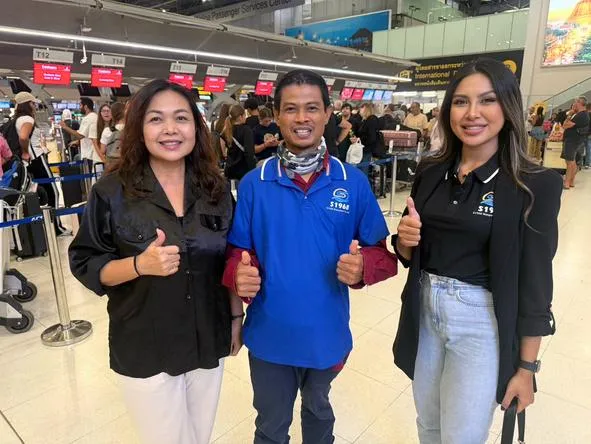
We recruit from Thai hotels and resorts and screen for what a housekeeping manager checks: a room turned to standard, linen and chemical handling, pace, and enough English to follow a supervisor and a checklist. You see the shortlist and the evidence before anyone is selected.
In Thailand the placement runs through the Department of Employment like any legal deployment: a legalised demand letter, an approved job order, medical checks and the pre-departure programme. Once the Croatian permit is issued, the worker applies for the long-stay D visa at the Croatian visa application centre in Bangkok. The visa fee is 93 euros, the centre warns that processing can take more than 45 days, and the application has to be filed within two months either side of the date the permit starts.
Count backwards from the first shift. Ninety days for the permit, up to six weeks for the visa, selection before both and a week or two of travel and onboarding after them come to roughly five to six months. For a May opening, sign in November. A crew signed in March arrives for the second half of the season at best.
Room attendant
Pay group
II
Minimum gross from May 2026
€1,060
Approved Jan-Sep 2026
3,453
Cleaner
Pay group
I
Minimum gross from May 2026
€1,050
Approved Jan-Sep 2026
6,318
Assistant cook
Pay group
II
Minimum gross from May 2026
€1,060
Approved Jan-Sep 2026
10,809
Assistant waiter
Pay group
II
Minimum gross from May 2026
€1,060
Approved Jan-Sep 2026
10,139
Is room attendant a shortage occupation in our area?+
It depends on the police administration area, because HZZ sets the list area by area. Where it is listed, there is no labour-market test and the 10% ratio applies. Where it is not, HZZ tests the market first and the ratio is 20%. We check the current list for your address before the file is opened.
Can the same housekeepers come back every season?+
Yes. A seasonal permit can run up to three years with the same employer, for up to 90 days or nine months of work a year depending on the type of seasonal work. Settle the full season in the application, and keep in mind that a seasonal worker cannot move to another employer while the permit runs.
Do seasonal housekeepers need to pass the Croatian exam?+
No. The A1.1 Croatian exam applies from June 2027 to workers on standard permits who have lived in Croatia for more than a year, and seasonal workers are exempt. Year-round staff in a city hotel will need it at renewal after that date, and the employer pays for the test.
What is the minimum we can pay a room attendant?+
Under the hospitality agreement, 1,060 euros gross basic pay a month from May 2026, plus 50% for Sundays and holidays and 30% for nights. Outside the agreement the national minimum of 1,050 euros applies. Applications approved this year averaged 1,137 euros, which is a better guide to the market.
When do we need to sign for a May opening?+
In November, or December at the latest. The permit decision alone can take 90 days, the D visa in Bangkok can take more than 45, and selection comes before both.
Sources
- Work-permit opinions by occupation and county, Jan-Sep 2026 - HZZ
- Hospitality collective agreement 2026, pay groups and supplements - HUP
- Foreigners Act amendments, ratio and A1.1 exam from June 2027 - Crowe Croatia
- Seasonal permits, employer change, test areas - Newland Chase
- Inflow and blocked-account conditions, 90-day deadline - WorkLiveCroatia
- Long-stay D visa at the Bangkok application centre - VFS Global
This page is written for employers. We do not place job seekers and do not accept applications from candidates: S.1968 Europe is the European representation of S1968 Manpower Co., Ltd., a Thai overseas-employment agency licensed by the Thai Department of Employment (licence Tor.1250/2565), and every worker is recruited under that licence in Thailand.
Plan your housekeeping teamCountry playbookCroatia